
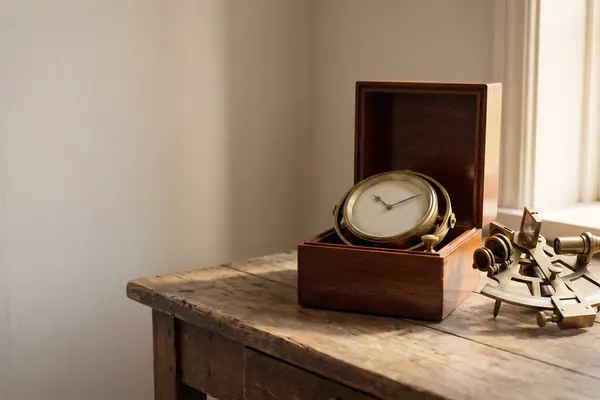
1714 · LONGITUDE
A reward set by Parliament
The Longitude Act offered £10,000, £15,000 or £20,000 depending on how accurately a method could find a ship's longitude, with up to £2,000 for trials.
See the numbers
HOW CHALLENGE PRIZES WORK
£20,000 offered in 1714
AI-generated image, not a photograph of a real person or place.
Some inventions were ordered in advance.
A government or funder describes a problem, sets out how success will be judged and promises a reward to whoever solves it first or best. It worked for longitude at sea in the 1700s, and it is still used today.
THE SHORT ANSWER
A challenge prize sets the goal and the test.
Anyone can try, in whatever way they think best.
1714 · LONGITUDE
The Longitude Act offered £10,000, £15,000 or £20,000 depending on how accurately a method could find a ship's longitude, with up to £2,000 for trials.
See the numbers1810 · FOOD
The French government paid Nicolas Appert 12,000 francs for his method of sealing heated food in glass bottles, on condition that he published it.
What happened next2014 · MEDICINE
The £8 million Longitude Prize on antimicrobial resistance rewarded a test that cut the wait for urinary infection results from 2–3 days to 45 minutes.
Does a prize fit?
HOW A CHALLENGE PRIZE RUNS
The formula Nesta describes is simple. The hard part is choosing the problem and the test.
Pick a problem that is clear enough to set an unambiguous goal for innovators.
Say what success looks like, without prejudging how anyone should achieve it.
Prizes aim to reach innovators that other funding misses, and often add mentoring, testing or seed funding.
Judge entries against the criteria and award the first or best solution. In 1714, half the reward waited for a trial voyage.
TWO NUMBERS WORTH KNOWING
One figure from the first British prize,
one from its modern namesake.
£20,000
Top reward offered by Parliament
Paid for a method finding longitude to half a degree of a great circle. Finding it to one degree, or sixty geographical miles, was worth £10,000.
LONGITUDE ACT · 1714
45 minutes
Wait for urinary infection test results
Challenge Works says the winning diagnostic device cut the wait for UTI test results from 2–3 days to minutes, helping doctors choose the right antibiotic.
LONGITUDE PRIZE ON AMR · 2014–2022
The 1714 Act was the first British government funding and reward for a specific scientific problem, according to the History of Parliament. The Commissioners it created only began meeting together in 1737.
A QUICK PROBLEM CHECK
Nesta, which runs the modern Longitude Prizes, lists the kinds of problem that suit a challenge prize. Pick a description to see how well it fits. The bar shows how strongly the guidance points to a prize.
Based on Nesta's description of when challenge prizes work best. General information, not a funding recommendation.

WHAT HAPPENED NEXT
Appert used glass bottles and did not patent his method. Grace's Guide records that an English patent for preserving food in containers, including tinplate, was sold to John Hall for £1,000, and Donkin, Hall and Gamble were producing canned food in London from 1813.
The longitude reward also outgrew its first purpose. Longitude Acts passed between 1714 and 1828, and the Commissioners became a standing Board that published the Nautical Almanac and supported other technologies.
In conversation
Nesta describes it as a reward offered to whoever can first or most effectively meet a defined challenge, through a public competition open to the widest possible community of innovators.
The Act set three tiers: £10,000 for finding longitude to one degree, £15,000 to two-thirds of a degree and £20,000 to half a degree. Up to £2,000 could also be spent on trials.
The French government paid Nicolas Appert 12,000 francs for his food-preserving method on condition he made it public, which led to his 1810 book. Others in England then developed tinned canisters.
Yes. Nesta lists the Ansari XPRIZE for private human spaceflight (awarded 2004), the DARPA Grand Challenges for autonomous vehicles (2004–2013) and the Longitude Prize on antimicrobial resistance (launched 2014).
Not always. Nesta sees prizes as one tool alongside grants, contracts and investment, best suited to well-defined problems where new innovators could speed up progress.
Each figure on this page comes from the sources below.
ABOUT THIS NAME
doodleinvention.com is part of the DoodleSale portfolio. It isn't in an auction right now, but you can ask about leasing it.